“Camping on the Colorado River was like DisneyLand… Bathrooms with toilet paper… it’s not real life.” – Pauline Morris (good friend and fellow teacher in Kwethluk)
Pauline is Yupik, born and raised in Kwethluk. She switches her language back and forth between Yupik and English as quickly and seamlessly as the river running outside my front door. Having traveled the world, even taken her children to Europe, she has an uncommon depth to her thoughts. Yet, she has the thick accent of a village elder with the native wisdom to match. She is funny (like the quote) and generous (sharing dried salmon every day at lunch). There are two high school Language Arts teachers here… Pauline and me. We have lunch together every day and I am learning about the true culture of the people here through her – the rhythm of the people versus the rhythm of the school. I am proud to call her my friend.
 |
Where Nali spends her weekdays on the run line
(it's raining in this picture so she was staying up under the
house - usually she's running around - the line is 15 feet long) |
The days are getting shorter and the weather is cooling off – lows in the mid-40’s and high’s in the low 50’s. But, the rain… the incessant rain. I had planned to go pick berries today – a 6 mile hike (round trip), but the rain may keep me homebound, again. I should have gone yesterday when the rain let up, but I wanted a lazy day at home – after all, it was Sunday. Today, I will pay for that – that ignoring of the rhythm of this place. Here, the seasons and the weather should dictate your schedule, not the calendar or the clock.
 |
| My Classroom |
Nonetheless, still bound by the clock of western civilization, my schedule here is simple. Weekdays, I get up at 7am and am in my classroom by 7:30, after having put Nali on the run line attached to our house. I prepare for the day (after checking my personal e-mail and facebook – which is blocked 8am-5pm). I teach from 8:30-12:20, then have a 30 minute lunch break when I visit with Pauline, and sometimes Christina (Asst. Principal, Elementary), while I eat whatever the school cafeteria is serving that day – usually something homemade and tasty (meatloaf and mashed potatoes, ham and au gratin potatoes, homemade cobbler). Back to class I go from 12:50-3pm. My Planning Period is at the end of the day, 3-4pm. Students usually come in right after school with questions or to finish up the day’s work so that they won’t have homework. I try to leave the school by 5 and head home to make dinner. Sarah has already come home and brought Nali inside, having wiped her down with a beach towel if it was rainy and muddy outside. Nali is so excited to see me that I immediately take her for a walk along the river (she runs, I walk) while I make my daily phone call to my dad.
 |
Homemade bread with homemade peach jam and a
homemade mocha - out here, everything is homemade! |
It doesn’t matter how tired I am, there are no drive-thru’s or pizza deliveries to be had. Dinner must be created, from scratch, every night (unless it’s leftover night). Sarah and I put in a movie to watch while we eat dinner and usually watch another one after dinner (we borrow movies from other teachers and are signed up with Netflix and Blockbuster to receive movies by mail – our only consistent form of entertainment). One of us washes the dishes – we trade off – all having to be done by hand since there is not one dishwasher in the entire village. Then, it’s off to bed to start all over.
 |
| Our current stock of movies. |
Weekends, I stay up a little later, sleep in a little later, and spend my days cooking (Chicken and Dumplings is cooking on the stove as I write this), cleaning house (the kitchen floor is currently calling my name), doing laundry (yeah, that’s calling my name, too), walking the dog, watching movies, working on lesson plans, writing my blog, and playing on the internet.
 |
| Our front steps |
Our front steps are metal - and spiky (that took Nali some getting used to). I’m guessing that’s to keep me from having to shovel them too much this winter and to keep them from getting slippery. The entrances to the school are all the same way.
 |
| Nali leaps over the above ground pipe on her way to the ramp. |
The only “handicapped” entrance to the school is the back door where there is a long ramp that weaves around like the waiting lines at DisneyLand. The interesting thing about this particular ramp is that it has wooden slats nailed across the middle of it every couple of feet which would make for a bumpy wheelchair ride. I’m guessing those also help keep the ramp from getting too slippery (giving your boot something to hold on to) in the winter. However, an even more interesting feature of this ramp is that it ends in the muddy grass, not too far from a large, above-ground pipe. It appears to be far from handicapped accessible in my estimation. But then, I’m not sure how this mysterious handicapped person would make it to the school in the first place – there’s no bus to pick them up. (things that make me go “hmmmm”)
 |
| The ramp (see the wooden slats). |
This week, school is closed today, Monday, for Labor Day. Tuesday and Wednesday are teacher inservice days (we will participate with the rest of the district via video-teleconference), and then we have class on Thursday and Friday. They lumped teacher inservice days in with Labor Day because it’s Moose Season and attendance will be low at school. The season actually started last Thursday. Students can pick up “Subsistence Absence” forms in the office to have teachers sign if the students know they will be absent certain days for hunting, fishing, or even berry-picking.
 |
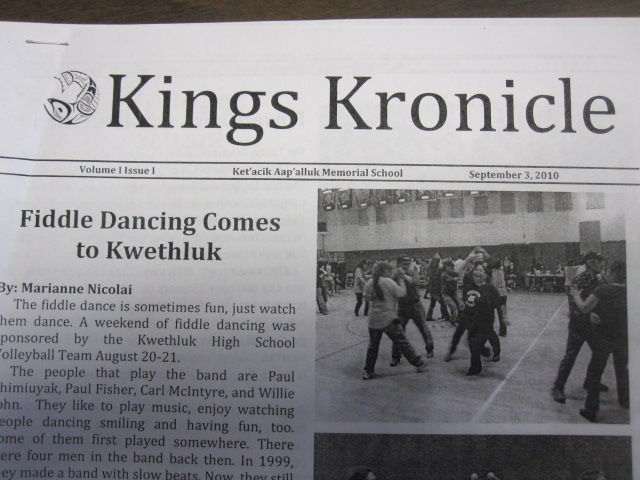
Our inaugural issue!
(Pauline's the one dancing in the middle of the picture.) |
It’s been interesting to note that even though the schools out here on the tundra have a hard time meeting AYP and the other state and federally mandated definitions for minimal education standards, the students here aren’t “low.” They’re “narrow.” Let me give an example. In my Journalism class, I started by talking with the students about the different departments of a newspaper and we brainstormed ideas for news articles for our own school newspaper. I assigned stories, set a deadline, and thought we were off on the right track. Wrong wrong wrong. The deadline came and went. I gave my class a stern talking to, set a new deadline and sent them off to do interviews.
 |
| Front and back pages of our first school newspaper. |
The second deadline came and went. I talked to Pauline at lunch about it and she reminded me that these kids have almost no experience with a newspaper – don’t realize that there are even newspaper delivery people in most cities. Wow, talk about a lightbulb moment! Pauline gave me a video to show the class (History Channel Modern Marvels – the Newspaper). We watched the video, talked about it… a lot, and I explained to them about newspaper delivery boys (sexist, I know) throwing newspapers from their bicycles. My students marveled at how a newspaper could be delivered to your front door every day! Breakthrough. Now, they understood why the deadlines were important, why the news had to get out in a timely manner, that the newspaper couldn’t be delivered if there were no articles, and that most reporters have to write new stories every day for a Daily Paper. My students had never heard of such a thing.
 |
| Inside pages of our first issue. |
I set a new deadline and about 1/3 of the class turned in articles. The paper (skimpy though it was) was printed and distributed. Now, the students understand, firsthand, the importance of meeting those deadlines.
Other examples of their “narrow” experience… We were reading a short story 10th grade Literature (The Open Window) and it described French doors that opened out onto a porch. The kids had never heard of, much less seen, French doors. Time to stop the lesson, find a picture on the internet and show them on the projector what a house like this might look like.
 |
| The view from my classroom window on Labor Day. |
We were reading a play in Theatre Arts (The Necklace) about a woman who borrowed an expensive necklace to wear to a fancy party (necklace probably worth $100,000 by today’s standards). The students couldn’t understand why that was important, why someone would want expensive jewelry, why it was important to impress other people like that. One student, in particular, kept insisting that a necklace isn’t important. I had to agree, but still get them to understand it’s significance in the culture of the story – turn of the century, Paris.
 |
puddles, puddles, everywhere -
thank goodness for rubber boots |
Well, the rain sounds like it’s letting up. The window is open because even though it is cool outside (and we have yet to turn the heater on), the walls of our house are a good eight inches thick, providing much needed insulation for the winter, and that means that whenever I cook (which is very often), the house gets too warm and I have to open the window. Right now, I hear the rain trickling down the metal roof and splashing into puddles surrounded by 2 foot tall grass. There is a dog howling in the distance, beginning to set off other dogs (there are many dog teams here). A truck (I know it’s a truck because there are no cars here) just drove past the front of the school, bumping and splashing through the puddles on the road. Now, it is silent again, except for the dripping outside.
Quyana (thanks) for your patience with my longwinded entry today.




 Sarah: Mom, you left your grape jui-, I mean you left your wine sitting over there.
 I have definitely come to realize that the relaxation associated with imbibing alcohol is largely psychological, at least for me. I swear I even thought I had a hangover one morning after having 4 or 5 glasses of “wine.” I actually had to take a Tylenol!
 One of the classes I am assigned to teach is Journalism. The school is excited at the prospect of actually having a school newspaper… for the first time in a long time, maybe the first time ever. “What an exciting opportunity!” one might exclaim. Well, yes… and no. You see, there are no newspapers available in Kwethluk other than the Delta Discovery, a locally owned and operated newspaper out of Bethel. The DD comes out once each week, is distributed free in the villages, and has only been in operation for about 3 ½ years. It has been making its way to Kwethluk for less time than that. Therefore, most of my Journalism students have had very little contact with an actual newspaper. Most have NEVER seen a large newspaper.
 The most interesting part of class right now is when we do our Journal writing. I (having a computer and projector for teacher use) project an image on the screen and have the students write about it. I tell them to pretend that they are a news reporter (some of them do have TVs and have seen news reports on television) and have just come across this scene. What’s the story? What’s going on? Answer the 5Ws and H (who, what, when, where, why, how). I tell them nothing about the picture until after they have had 10 minutes to write. Then, we discuss. These discussions have been my most teachable moments in Kwethluk thus far. Our first picture was of the new-age bus system that China is building in Beijing. It had been at the top of the Yahoo! news feed over the weekend and provided ample discussion in class Tuesday afternoon.


.png)


